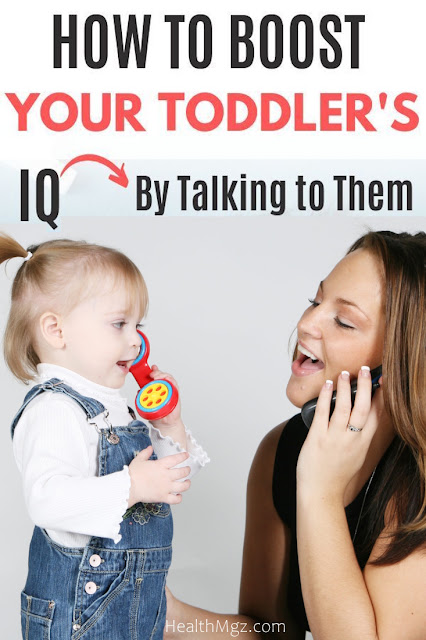
A famous 1990 study was
the first to differentiate toddlers’ vocabulary performance according
to their socioeconomic background. Rich families were more likely to
spend more time with toddlers, thus feeding them more complex words.
Poor families, on the other hand, had a more basic vocabulary to pass
on.
However, a 2018 study has now shed a new light over the subject by concluding that the important thing is not to talk to toddlers, but rather talking with toddlers.
A study shows that talking with toddlers can increase their IQ

The importance of talking to toddlers to stimulate their vocabulary
was already well-known, but a 2018 study has come to show that talking
with toddlers is as or even more important.
The researchers analyzed toddlers between 18 and 36 months and
calculated the rate of adult-toddler conversations and the amount of
vocabulary used based on daylong audio recordings. 10 years later, they
met the same children to evaluate their cognitive development and the
results were clear.
The children who had maintained more conversations with adults as toddlers presented a 14% to 27% higher IQ
in the categories of verbal comprehension, and receptive and/or
expressive vocabulary than those we were simple receptors of vocabulary.
According to the researchers, a conversation implies that the child has to create and produce language.
They have to put words, meanings and structures together, which
stimulates areas of the brain that simply listening to someone talk
doesn’t.
Even if the toddler cannot yet speak clearly, the effort to try to
communicate will eventually result in a better and faster development of
their mental capabilities.
Tips to boost your child’s IQ
The evaluation of someone’s IQ covers several areas. For a child,
these focus on 7 points: language, information, memory, math, spatial,
thinking and motor skills.
If you want to boost your child’s IQ these are the areas you should
be focusing on. They are the primary base of development for your baby
and will impact on their learning capabilities through their life.
Read to your child
 Pexels
Reading to your child doesn’t fall into the category of talking with toddlers but it’s not a simple act of reception.
Not only will you be increasing their vocabulary, you will also be stimulating their imagination, their time perception and the relation between cause and consequence as they need to follow what happens to each character.
You can even take the opportunity to take up other areas that not vocabulary only.
Ask your child to repeat the story after you finished to practice their
memory, for instance. Use the book drawings to ask other developing
questions too: How many trees do you see in this picture? What color is
this house?
If you’re really into it, you can even ask your child which part of
the book they would change, ask them why and request a retelling of
their own. This will stimulate their memory, imagination and creativity
but also their communication skills and vocabulary.
Introduce math early on
Mathematics is the boogie man of many children and adults alike. If
you want to improve your child’s IQ then you need to make him
comfortable around numbers and basic math processes.
Math is a subject that needs to be built up. You can’t learn complex functions if you don’t understand the basis behind 2+2=1. If
you introduce them early on to your child it will become a natural
rational thinking and not something he needs to consciously make an
effort to think about.
Start with simple things. For example, “Do you want one or two
candies?”, “If you have 4 french fries and eat 2, how many do you have
left?” Even without realizing it, you will be talking with toddlers by
doing this. You ask and expect an answer from them, so you are joining
two learning processes in one.
These are simple processes and very easily accompanied by a visual
cue, but they can make a big difference later in your child’s life.
Let your child explore
 Unsplash
Take your baby outside and let him experience the world. Let the
toddler feel the rough texture of sand in their hands, smell a flower or
destroy it to see what it is like inside.
Physical touch is very stimulating for young children when their brains are still developing. Just keep around in case they try to experience it with their mouths.
Let the tots play
If possible, let your child play with other children of the same age from early on.
Let them experience the structures and dynamics of social
interactions and learn how to manage them, how it is like to make
friends, how it is like to have an argument with a peer.
Keep talking to your child
Talking with toddlers is great but it also requires attention on your
part, which can make it hard to do it for long periods of time and very
often.
However, even when you’re running short on time or have to
focus on other activities you should keep talking to your child about
everything, even the most random things.
If you’re about to cook, start describing to your child each step
you’re taking as if you were in a cooking show. When you hear a bird
sing, tell the toddler to pay attention and explain the sound is coming
from a bird, describe what a bird is, what they eat, what they do, etc.
You will be basically feeding your child with new vocabulary but also with important and educational information.
Let your toddler play with educational toys
 Unsplash
Puzzles, Lego, building blocks, these sort of toys explore the child’s creativity and imaginal but also their spatial skills and fine-motor skills.
They have to use their brains to solve the puzzles or create new
shapes and toys with the blocks and Lego. They will also need to improve
their fine skills, working with their fingers to build and destroy
their creations.
Should you teach them how to read?
Why not? If you’re willing to try and have the patience to do it, then go for it.
Just keep in mind that you will be dealing with a toddler whose brain
is still developing. You can’t be as demanding or hard on them as you
are with a pre-school child, for instance.
There are several methods and techniques to teach young children how
to read. When choosing one, think primarily of your child and which
technique would be more interesting or suitable for them.